
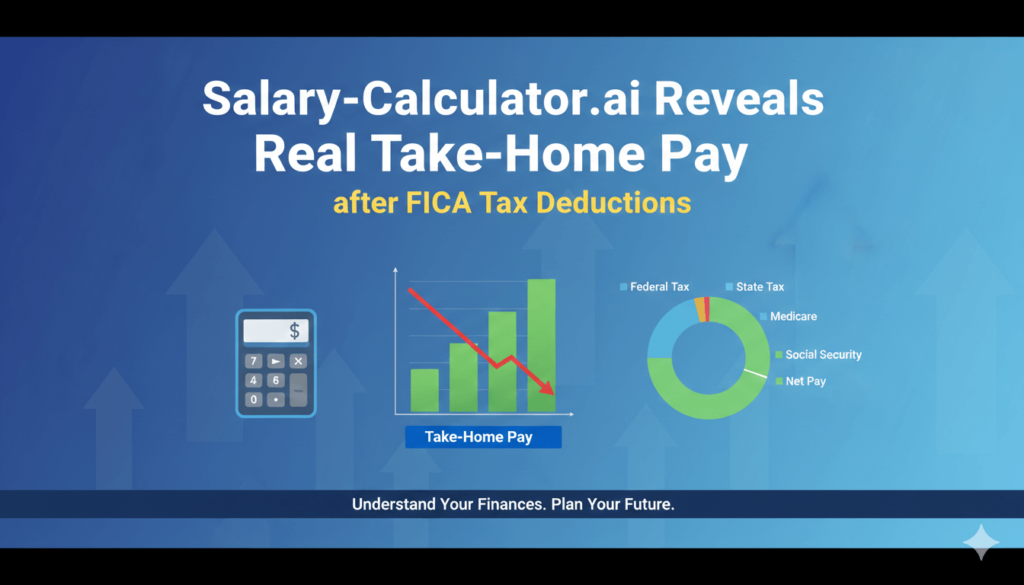
Salary-Calculator.ai has delivered a better take-home pay calculator to be used by American workers so as to know their true earnings after the deduction of FICA tax, among other mandatory withholdings. The tool also handles the increasing fears of financial literacy by offering a breakdown of how the Social Security tax, Medicare tax, and federal income tax minimize the gross salary to net earnings.
What Is Take-Home Pay and Why Does It Matter?
Take-home pay is the amount of money deposited into the bank account of a worker after all the mandatory deductions are made from the gross salary. To a lot of American employees, the difference between the salary offered and the true net income causes confusion with financial planning, salary meetings, and budgeting choices.
The calculator takes into consideration FICA tax, two taxes that comprise Social Security tax (6.2% on earnings to date, to $176,100 in 2025) and Medicare tax (1.45% on all earnings), and current taxes. These payroll taxes amount to 7.65% of the payroll of the majority of employees. with high earners who would be subjected to an extra 1% Medicare surtax on their wages above $200,000 as single filers.
Based on studies on financial literacy, a significant number of employees are surprised when they get their first paycheck and find out that there is a tremendous disparity between the gross and net earnings. The platform seeks to remove this lack of contact by enabling correct calculations to be done before employees accept employment or enter significant engagement.
Role of FICA Tax Deductions in Decreasing Gross Salary
FICA tax benefits are automatically provided by means of payroll deduction, and the contribution made by employers is dollar-to-dollar matched. Employees contribute 7.65% in symptoms in relation to the FICA taxes, whereas employers give 7.65%, amounting to 15.3%, which subsidizes the Social Security and Medicare schemes. There are two parts collected from self-employed persons, and hence the self-employment tax amounts to 15.3% on the net income.
To a worker who earns an annual salary of $60,000, the deductions taken by FICA tax amount to roughly $4,590, even before taking into consideration the federal income tax, state income tax, or any other deductions. After all the compulsory deductions are made, the gap between the gross pay and the take-home pay can be 25-30% in the case of many employees.
The platform works out the calculations of different employment instances. Hourly employees are in a position to know the amount of overtime that they will owe them and to calculate the tax that they will pay, whereas the salaried employees are able to compare the benefits packages to find the net compensation worth. Independent contractors and freelancers have a chance to estimate the total self-employment tax liability.
Native State Calculation and Local Tax Differences
Take-home pay is also majorly dependent on location because of the disparity associated with state income tax rates. Employees in the non-income tax states, such as Texas, Florida, Nevada, Washington, and Tennessee, will receive a greater portion of their gross income than employees in the high-tax states, such as California, New York, or New Jersey, where state and local taxes could amount to over 10% of gross income.
The calculator uses state-specific calculations in all 50 states, including local income taxes where they exist. Such geographic differences will allow employees to compare job opportunities elsewhere and determine the ways in which moving to a different location will affect their net income.
In addition to geographic reasons, the tool entails federal income tax rates of 10% to 37% in 2025. The employees will be able to make calculations depending on their filing status, the number of dependents, and W-4 withholding allowances to assign estimated take-home pay under various conditions.
Pre-Tax Benefits and Additional Withholdings
The platform takes into consideration pre-tax deductions that cut the taxable income but decrease the total tax amount. Contributions towards traditional 401(k)s, health savings account deposits, and some health insurance premiums are exclusionary to the calculation of federal income tax, which effectively increases take-home pay by lowering the tax contribution amount.
Tax breaks are also a factor in the net income. The garnishments mandated by the courts to pay child support or collect past due payments, membership fees, contributions made to disability insurance, and voluntary contributions are deducted after tax calculations, leaving the workers with even less money to take home in their pay package.
The combination of gross salary, pre-tax deductions, withholdings imposed by tax, and post-tax deductions will give the workers a broad understanding of the real salary they earn. Each element is broken down in the calculator so that one can see the particular way gross pay becomes net pay.
Real-Life Applications of Financial Planning
To qualify/approve a mortgage or a loan, the debt-to-income ratio is usually calculated using gross income by the financial institutions. The consumers should, however, be able to budget based on the net income, the real money to make monthly payments. Such a mismatch may cause financial pressure when employees expect to have more cash flow than they actually do.
Imagine a laborer who is given the offer to have a pay of $75,000 annually. Their absence of these calculations may lead them to think there is a monthly income of $6250. Once FICA taxes ($5738/yr), federal income tax (est. $8500), and state income tax (depending on the location) are paid, the actual take-home pay may be between $4500 and $5000 per month, which represents a large difference in savings on housing and general financial stability.
The system allows employees to assess the financial adequacy of salary packages in relation to their finances during the process of guaranteeing that they accept jobs. Having the calculation of the necessary gross salary depending on desired take-home pay, the worker will be able to bargain in the salary negotiation with realistic expectations and definite figures.
About Salary-Calculator.ai
Salary-calculator.ai is a financial planning tool aimed at allowing the American people to know their real income after taxes and deductions. The tool offers free pay calculators that consider the FICA tax, federal and state taxes, and other withholdings to provide the net remuneration. Attended to by computing every 50 states and various job categories, the site has been customized to cater to the hourly workers and the professionals who are salaried, as well as those who are self-employed. The service would make financial literacy and transparency a priority by establishing an understanding of complicated payroll computations.
Media Contact
Jenna Tang
Product Manager, Salary-Calculator
Email: contact@salary-calculator.ai
Website: salary-calculator.ai